Explore the Science

What a decade of polar plankton research has taught us.

Plankton Base grew out of ten years of Antarctic and Arctic fieldwork. Below is a brief tour of what that science has shown — followed by the peer-reviewed papers behind each finding.

What we've discovered

Four things we now understand about polar plankton — and didn't before.

Each of these findings comes from the peer-reviewed studies listed further down the page.

A brand-new species of Antarctic plankton

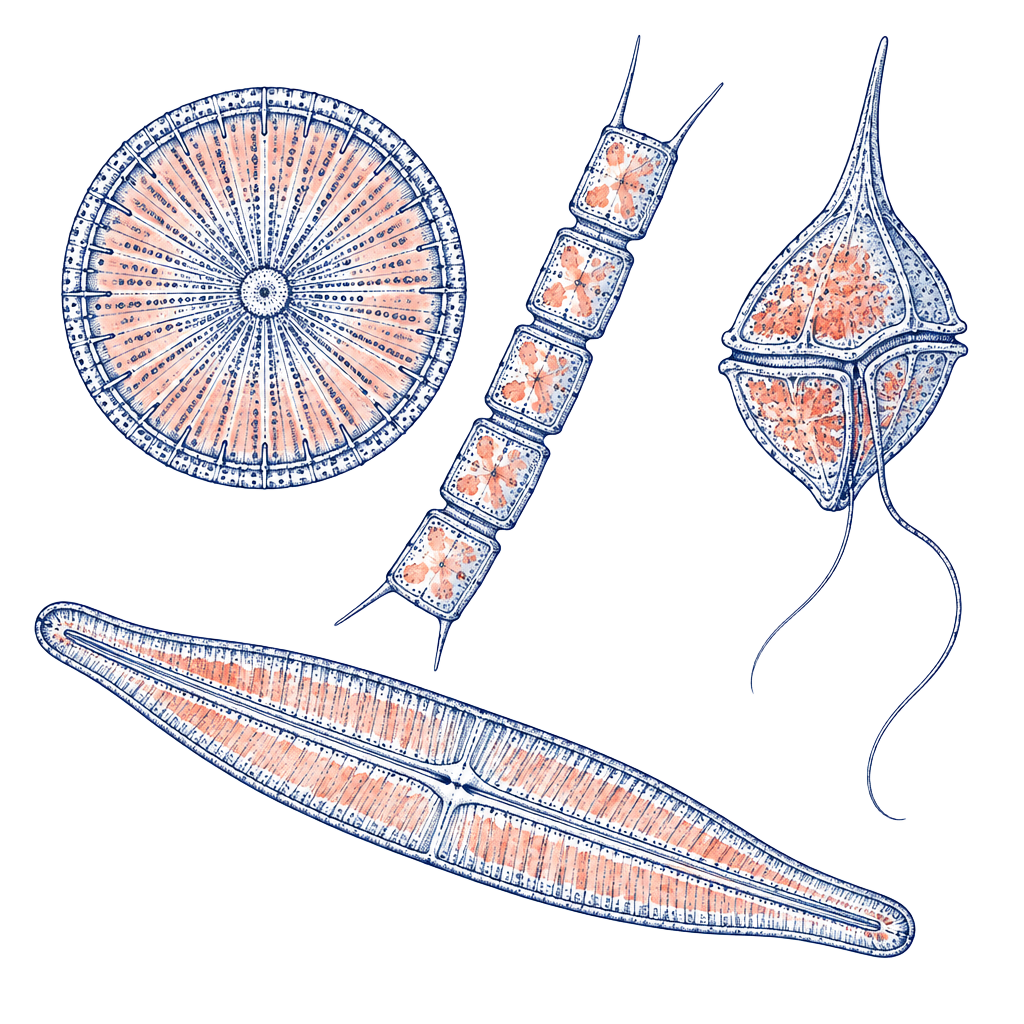
During an exceptional bloom on the western Antarctic Peninsula, molecular sequencing revealed that the naked dinoflagellates driving it belong to a previously undescribed species in the Gymnodinium group — a genuinely new organism on the tree of life.

From: Mascioni et al., 2025 — molecular evidence for a new Gymnodinium species
The first seasonal look of plankton in unmonitored fjords

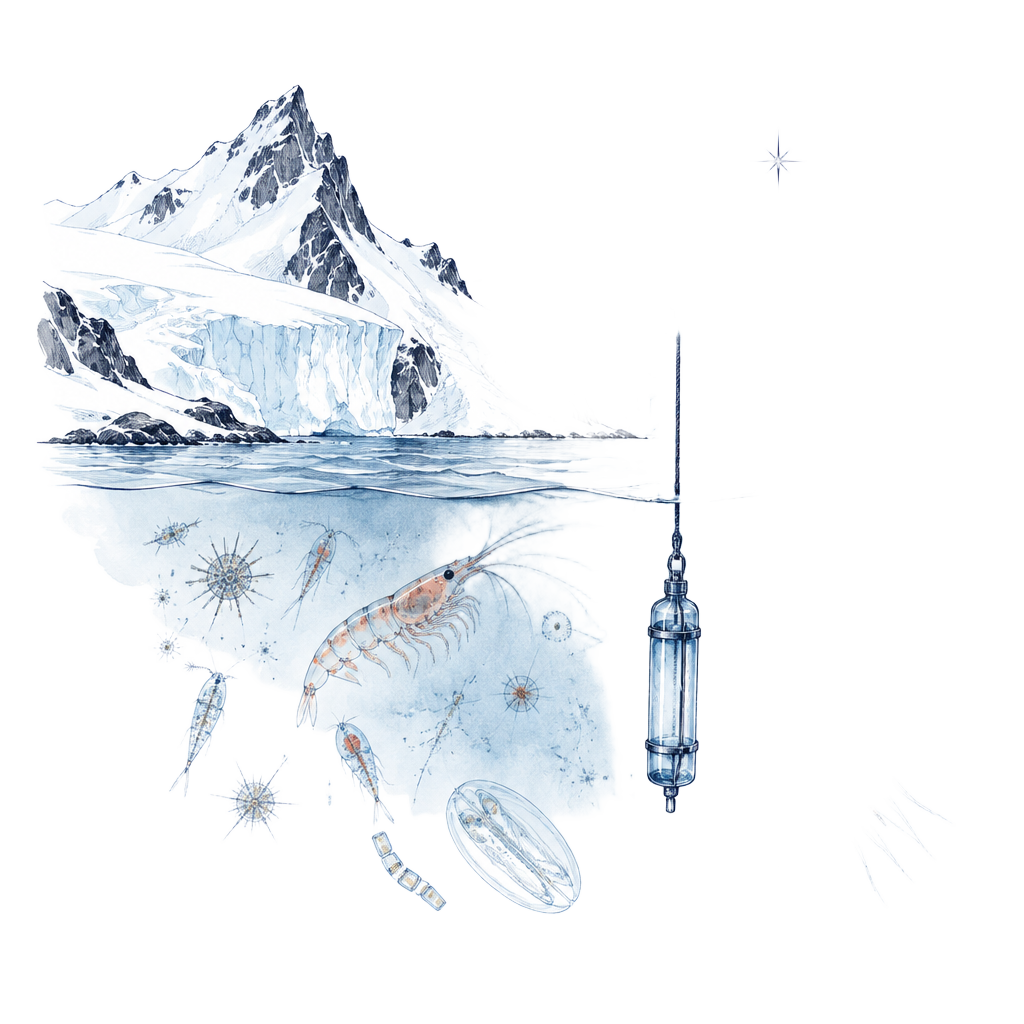
Most Antarctic phytoplankton research happens offshore from research vessels or select research stations. Sampling from expedition ships gives us a more detailed picture of what actually blooms in the nearshore fjords where glaciers meet the sea — and how those communities shift through the season.

From: Mascioni et al., 2019 — Polar Biology

Can a citizen science project enrich travellers' experience in Antarctica?

A preliminary evaluation of the FjordPhyto project found that giving travellers a hands-on role in Antarctic research deepened their sense of connection to the polar environment and made the science more meaningful — for visitors, expedition staff, and the research team alike.

From: Cusick et al., 2025 — The Polar Journal

Polar tourism can produce real, rigorous science

Travelers on expedition vessels — trained and supported by scientists on board — can generate peer-review-quality oceanographic data at a scale no single research cruise could. This is the framework Plankton Base carries forward.

From: Cusick et al., 2020 — Oceanography
Where the data goes

Open data that feeds global research networks.

Plankton Base publishes data openly so it can be used by scientists, educators, and communities worldwide.

UN Ocean Decade 2021–2030Sustainable Development Goal 14: Life Below Water

UN Ocean Decade & SDG 14

Our open data supports the UN Decade of Ocean Science for Sustainable Development, advancing SDG 14: Life Below Water.

Ocean Biomolecular Observing Network

OBON

The Ocean Biomolecular Observing Network (OBON), a UN Ocean Decade programme, uses biomolecular data like ours to understand how ocean life is responding to change.

Southern Ocean Observing System

SOOS

The Southern Ocean Observing System (SOOS) coordinates long-term observation of the Southern Ocean, and our time-series data helps fill nearshore gaps.

Fifth International Polar Year 2032–33

5th International Polar Year

IPY5 (2032–33) will advance polar research and climate understanding. Our participatory model and open dataset are designed to contribute directly to that global effort.

How our data works

Open-access and FAIR — what that actually means

You'll see us say our data is "open-source" and follows "FAIR" principles. In plain language: open-access means the front door is unlocked and there's no cover charge — anyone can read, download, and share the data. FAIR means that once you walk in, the library is actually organized, the books are in a language everyone speaks, and the pages aren't glued together.

Open-access

Our datasets are free of charge, free of paywalls, and free of restrictive copyright. A polar researcher in Argentina, a high-school teacher, or a curious traveler all have the legal right to read, download, and reuse them.

FAIR principles

A global scientific standard that makes data genuinely usable — not just posted online. Every dataset we publish is built to be Findable, Accessible, Interoperable, and Reusable by both humans and machines.

Findable
Each dataset gets a permanent digital address and rich metadata, so a scientist searching for Antarctic plankton blooms can actually locate ours.
Accessible
No university login, no expensive software — anyone with an internet connection can retrieve it through standard, open protocols.
Interoperable
We use shared, non-proprietary formats so our records combine cleanly with NASA satellite data, British Antarctic Survey records, and other long-running datasets.
Reusable
Clear licensing and detailed documentation of equipment, coordinates, and methods let climate modelers and researchers trust, replicate, and build on the work.
Outputs

Everything this work has produced.

Open data, papers, theses, films, exhibits, talks, and press — a decade of polar plankton science.

Data access

Occurrence records, sequences, and data files live in public repositories for anyone to reuse.

Peer-reviewed papers

Most recent first. Key studies carry a tag.

  1. 2025

    Can a citizen science project enrich travellers' experience in Antarctica? Case study of a preliminary evaluation of the FjordPhyto project

    Cusick et al.The Polar Journal — Public Engagement with Polar Regions (special issue)
  2. 2025

    Molecular evidence reveals that naked dinoflagellates that formed an exceptional bloom on the western Antarctic Peninsula belong to an undescribed species within the Gymnodinium sensu stricto group

    Mascioni et al.Peer-reviewed (PubMed)
  3. 2023

    Phytoplankton dynamics in nearshore regions of the western Antarctic Peninsula in relation to a variable frontal zone in the Gerlache Strait

    Mascioni et al.Frontiers in Marine Science High impact
  4. 2021

    Microplanktonic diatom assemblages dominated the primary production but not the biomass in an Antarctic fjord

    Mascioni et al.Journal of Marine Systems
  5. 2020

    Polar Tourism as an Effective Research Tool: Citizen Science in the Western Antarctic Peninsula

    Cusick et al.Oceanography Foundational
  6. 2020

    A Helping Hand in Phytoplankton Research

    Cusick et al.ECO Magazine
  7. 2019

    Citizen Scientists in Antarctica: FjordPhyto Approach to Understand Climate Change Affected Environments

    CusickNarrative Inquiry in Bioethics
  8. 2019

    Phytoplankton composition and bloom formation in unexplored nearshore waters of the western Antarctic Peninsula

    Mascioni et al.Polar Biology Most cited

Theses & dissertations

Student research built on this dataset.

  • Dr. Allison Cusick — PhD dissertation, UC San Diego (Scripps Institution of Oceanography)

    Analyzing the first four years of FjordPhyto data

    Recipient of the UC San Diego Inaugural Innovation Award. The public defense is recorded and free to watch.

  • Dr. Martina Mascioni — PhD, Universidad Nacional de La Plata

    Phytoplankton taxonomy and bloom dynamics of the western Antarctic Peninsula

    The doctoral defense was held and recorded in Spanish.

  • Shailey Heller — master's thesis, 2025

    Illuminating the Polar Night: an Analysis of Phytoplankton Communities in Svalbard through Citizen Science and Genetics

    Built on samples collected by the Hearts in the Ice explorers overwintering in Svalbard.

  • Julia Lowe — master's capstone, 2025

    Learning on Vacation: Knowledge Gain and the Value of Phytoplankton Sampling

    How participating in science changes what travellers take home from Antarctica.

  • Brooke Dixon — independent study

    Designing the FjordPhyto traveller surveys

    The survey instrument Brooke designed produced the program's first social-science publication (Cusick, Dixon et al., 2025, The Polar Journal).

  • Celeste Kroeger-Campodónico — master's capstone, published as a bilingual book

    Science Goes on Vacation: a book for travelers discovering Antarctica's microscopic forest

    A phytoplankton identification guide for non-scientists. Five years in the making, and winner of a Phycological Society of America award in 2024.

Talks & presentations

Conference talks, public lectures, and recorded sessions.

  • With Steve Mandel and Raphe Kudela

    California Academy of Sciences Night School — plankton and the people who watch them

    Organised by Steve Mandel, a FjordPhyto traveller who spent six years of his retirement on plankton photography.

  • Plankton Base / FjordPhyto science team

    Genomics at Sea with Viking

    The shipboard genetics program, featured on Viking's own channel.

  • Viking.TV — Allison Cusick, Damon Stanwell-Smith, and Laura Smith

    Exploring Citizen Science

  • Viking.TV — Allison Cusick, Damon Stanwell-Smith, and Daniel Moore

    Scientific research aboard Viking Octantis

  • FjordPhyto on YouTube

    See past videos from the FjordPhyto team

Art, film & exhibits

When the science leaves the lab.

  • Amir Hossein Khazaei — Non-thesis MS in Visualization, Texas A&M University

    The Invisible Forest

    An interactive installation bringing Antarctic phytoplankton to human scale: around 2,000 scanned specimens from the expedition informed procedurally modeled 3D plankton, animated in an interactive ecosystem projected onto a data-informed, iceberg-like metal sculpture. As viewers approach, the phytoplankton dissolve. Fulfilling work for his master's degree; not recorded.

  • Entangled Others Studio

    Diatomic Garden

    A generative digital artwork grown from diatom forms.

  • Gabriela Lamanna — master's capstone film, 2020

    Drifters of the Sea: Antarctic Citizen Science

    A documentary short about the drifting life that feeds the ocean, told through the people who sample it.

  • Disney+ / National Geographic

    Tiny Things — with Jeff Goldblum

    Plankton on prime time.

  • Steve Mandel — FjordPhyto traveller

    Microscopic photography portfolio

    Six years of retirement spent photographing diatoms, beautifully.

Education programs

Bringing polar science into classrooms.

  • NASA OCEANOS

    Four years of bringing polar, participatory, and NASA ocean science to high-school and undergraduate students in Puerto Rico.

  • NASA Infiniscope — virtual Antarctic field trip

    Three online education modules plus an immersive 360° Antarctic field trip built from footage shot on expedition.

  • AUIP study abroad to Antarctica

    Four consecutive years of undergraduate study-abroad expeditions sampling alongside the science team.

Press & media

Selected coverage.

  • NPR Short Wave podcast — Martina Mascioni, 2025

    Here's how tourists are solving a plankton puzzle in Antarctica

  • NASA Science — Allison Cusick, 2025

    Newly Minted Ph.D. Studies Phytoplankton with NASA's FjordPhyto Project

  • Fluid Imaging — Martina Mascioni and Allison Cusick, 2023

    Citizen Science Meets Polar Plankton with FjordPhyto

  • RBR Global — Martina Mascioni and Allison Cusick, 2023

    FjordPhyto: Citizen science in the Antarctic

  • Women in Ocean Science, 2022

    Polar Scientist: An interview with Allison Cusick

  • Abro Hilo, TV Pública Argentina — Martina Mascioni, 2023

    Ciencia Ciudadana: vos también podés ser parte

  • Rewildology podcast — Allison Cusick, episode 75, 2022

    Using Science & Tourism to Uncover the Mysteries of Antarctica

  • Antarctica21 Journal, 2018

    An Interview with Allison Cusick, Polar Scientist and Citizen Science Leader